
Why we started
Roughly 60,000 people in the United States receive general anesthesia every day.¹ More than a third of inpatient surgical procedures are performed on patients 65 or older.² The standard governing how all of them are monitored requires four things to be evaluated continually: oxygenation, ventilation, circulation, and temperature.³ It was first adopted in 1986. It was last amended in October 2025. In neither version, nor in any between, does it ask for a measure of the brain, which is the organ anesthetic drugs act on.
The brain can be measured. Under general anesthesia, it produces a distinct electrical signature, including a slow alpha rhythm at the front of the head that arrives with loss of consciousness. An EEG reads it through the skin of the forehead.
The difficulty is what the industry built on top of that signal. Depth-of-anesthesia monitors compress the EEG into a single number, and the ones in clinical use were developed largely on younger adults. In a study of 155 patients aged 18 to 90, EEG oscillations in elderly patients were roughly two to three times smaller in amplitude than in younger adults, with alpha power falling furthest of all.⁴ The authors' own conclusion was that commercial depth-of-anesthesia indices do not account for age and are therefore likely to be inaccurate in elderly patients.⁴ The error runs in one direction. A brain state that reads as adequately anesthetized at 40 can read as too light at 80, and the patient is given more drug. Older patients are correspondingly more likely to enter burst suppression, the deepest anesthetic state, in which the EEG falls silent for seconds at a time.⁴,⁵
That matters because anesthetic exposure is one of the few modifiable contributors to postoperative delirium, which affects between 13 and 42 percent of older surgical patients⁶ and costs Medicare an average of $44,291 per patient in the year that follows.⁷ The cost is not the patient's alone. When researchers scored delirium-related distress on a five-point scale, patients who recalled the episode averaged 3.2 and the nurses caring for them averaged 3.09. The highest score belonged to a third group: the spouses and caregivers sitting beside the bed, at 3.75.⁸
In 2018, three doctor and engineers from MIT set out to fix the measurement.
Meet The Leadership Team

Emery N. Brown MD, PhD
Co-Founder | Chief Medical Officer
Emery N. Brown is an Institute Professor at MIT, the Institute's highest faculty honor and one held by twelve people. In January 2025, he received the 2024 National Medal of Science, the nation's highest scientific honor. He is the Edward Hood Taplin Professor of Medical Engineering and Computational Neuroscience at MIT and the Warren M. Zapol Professor of Anaesthesia at Harvard Medical School, and he practiced anesthesiology at Massachusetts General Hospital for more than three decades. An anesthesiologist and statistician by training, he established how anesthetic drugs act on the brain and developed the signal-processing methods that make those effects visible.
Dr. Brown is the author of 323 scientific papers and holds 48 patents, and he is a member of the National Academy of Inventors. He is the first African American, the first statistician, and the first anesthesiologist elected to the National Academy of Medicine, the National Academy of Sciences, and the National Academy of Engineering.
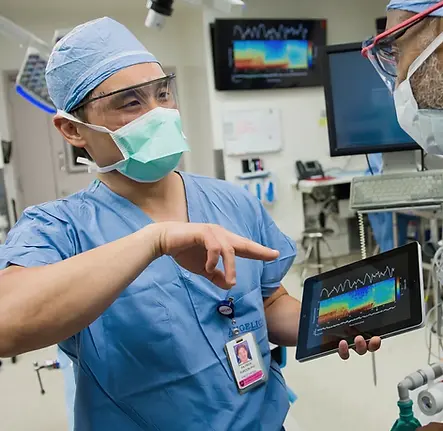
Patrick L. Purdon PhD
CoFounder | Director of Engineering
Dr. Patrick L. Purdon is Professor of Anesthesiology, Perioperative and Pain Medicine at the Stanford University School of Medicine and, by courtesy, Professor of Bioengineering, and a member of the Stanford Wu Tsai Neurosciences Institute. An engineer by training, he earned an A.B. in Engineering Sciences summa cum laude from Harvard College, an S.M. in Electrical Engineering and Computer Science from MIT, and a PhD in Biomedical Engineering from the Harvard-MIT Division of Health Sciences and Technology. His laboratory studies the brain dynamics of anesthesia, aging, sleep, and Alzheimer's disease, and builds the monitoring technologies that follow from that work.
A collaborator with Dr. Brown for more than two decades, he is a Fellow of the American Institute for Medical and Biological Engineering and a recipient of the NIH Director's New Innovator Award. He has authored 118 scientific papers and holds 16 patents.
He co-founded PASCALL in 2018 and serves as its Chief Scientist, leading the translation of research into monitoring technology.

Tuan Le Mau PhD
Co-Founder | Chief Executive Officer
Dr. Tuan Le Mau is the co-founder and chief executive officer of PASCALL, which he has led from its founding in 2018 through FDA clearance of the M0 brain monitor in 2022 and into its current work on an anesthesia index built for the aging brain. He is the principal investigator on ten NIH research grants—a portfolio spanning the company's brain-state index, dosing guidance, clinical systems integration, and nociception monitoring.
Dr. Le Mau earned his B.Eng. in Electrical and Electronic Engineering from Imperial College London and his PhD in Brain and Cognitive Sciences from MIT, and he has worked with Dr. Brown on brain research since 2013. Before founding PASCALL, he was a Principal Investigator at A*STAR Singapore. He has founded three companies and co-founded two nonprofit organizations
Trevor Barcelo MBA
Chief Operating Officer - Vice President of Engineering
Trevor W. Barcelo is Chief Operating Officer and Vice President of Engineering of PASCALL, which he advised on electronics from 2020 before joining. He leads development of the company's EEG-based brain monitoring platform and is accountable for engineering, quality, and operational execution.
He spent 22 years at Linear Technology and, following its acquisition, Analog Devices, designing analog and mixed-signal integrated circuits before leading design and product organizations that released more than 60 products. There he directed product and market strategy for a $100 million vital signs monitoring business, work that first brought him to wearable physiological sensing. He has since led engineering and commercial organizations at Titan Advanced Energy Solutions, Cambridge Consultants, and Richtek USA. He holds 11 US patents and degrees in physics from Harvard, electrical engineering from Stanford, and an MBA from MIT Sloan.